JFL Fellows, NHI Programs
Five NHI summer interns have ‘very unconventional’ experiences filled with learning and growth
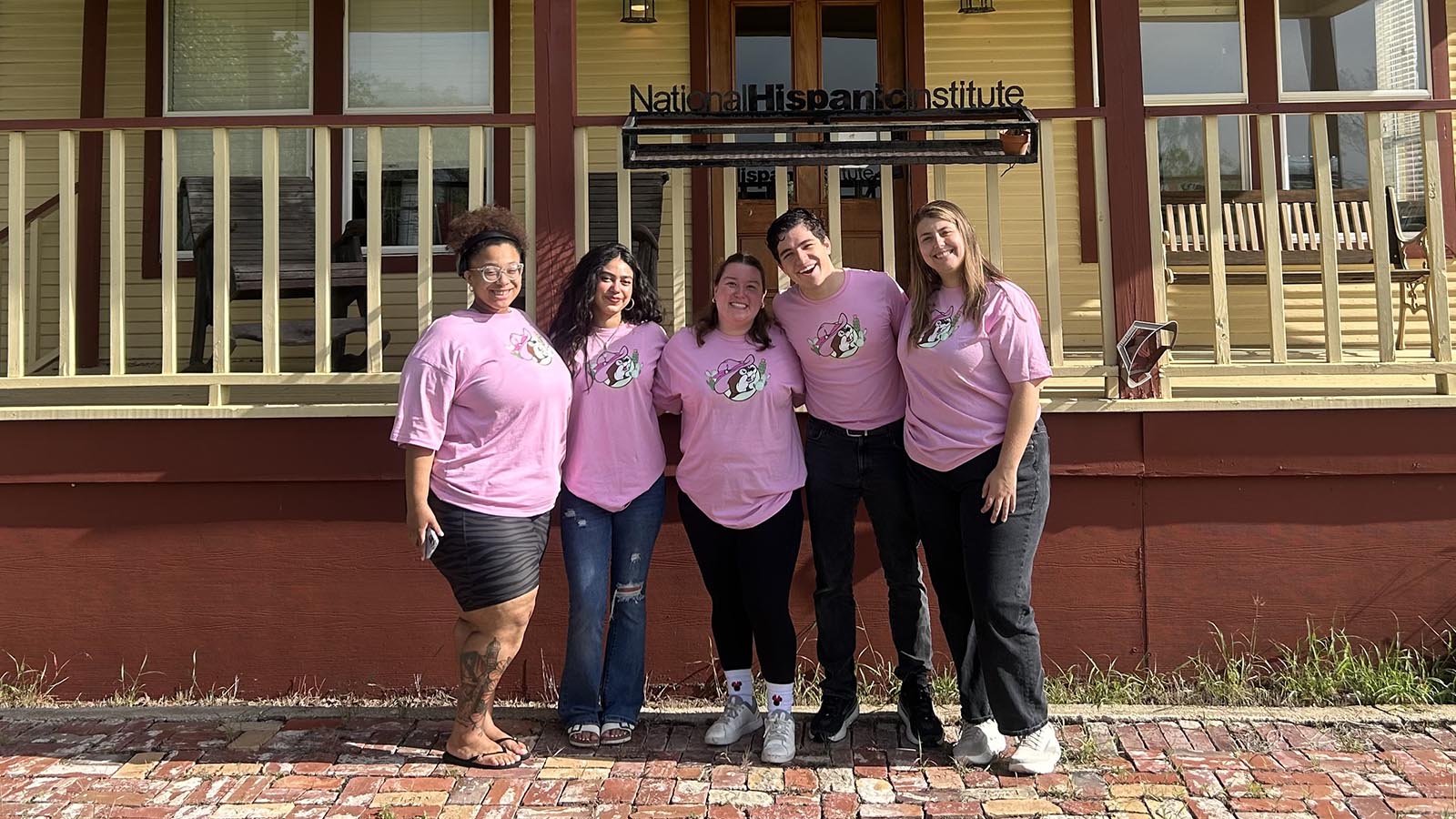
This year’s group of John F. Lopez, Jr,. fellows hail from universities spanning from West Coast to East Coast, and brought a diverse set of skills and interests to NHI headquarters for an experience that one called “very unconventional.”
Dan Goebel, a Pace University student who traveled to Maxwell for the summer experience, explained that observation further, noting that “you have to set your own deadlines.” His big takeaway from the experience was “having the time management to accomplish all of those goals that are in your mind without overwhelming yourself.”
His capstone project focused on making a more workable and user-friendly set of guides for staffers running the Lorenzo de Zavala (LDZ) Youth Legislative Session.
“My goal was to go through every single one of these guides, create new guides and just break them down completely,” he said, making sure that they incorporated day-to-day checklists that staffers could utilize. “I made sure to make them very visually appealing,” he added, citing the attention spans of busy staffers juggling assignments in order to create an optimal LDZ experience.
Emely Zelaya, one of two students at Sewanee: The University of the South who became JFLs this year, had an unusual perspective for those who work at NHI headquarters — she hadn’t been to an NHI program before. She participated as a JFL in part because of the relationship Sewanee has with NHI and the school’s effort to build up its first-generation college student program.
Zelaya found NHI to be welcome, which she felt at headquarters among the organization’s core leaders, as well as the Texas Star Great Debate, where she served on staff and got her first introduction to NHI teachings.
“I definitely felt a community of support and people who were constantly offering me advice and allowing me to experience it for myself,” she said. “But also, there were always people throughout the week, letting me know, ‘Emely, I noticed you did X, Y, and Z, and I really enjoyed that,’ or ‘you’re doing a great job,’ or ‘these kids on your team, I noticed that they did this, and I’m sure that that was because of the way that you’ve been coaching them.’ It was my first program, and it was a little scary, but I felt very, very supported and very seen.”
For her capstone project, she developed a plan to bring NHI innovations to Sewanee first-gen students, most notably an element of this year’s Great Debate “where kids had to call back to a piece of advice or a cultural tradition or story that has helped them or guided them.”
Heaven Poles, who attends New York University, returned to NHI headquarters for a second straight summer after initially serving as a JFL in 2025, and found the experience both expanded her knowledge of how NHI works and helped her in her role as a leader of the NHI East Coast Alliance.
“I got to be associate program manager for the American LDZ, so I actually got to see the ins and outs, the systematic ways behind the programs,” she shared. “I got to recruit a bit in the New York City schools, which was a networking opportunity, meeting new kids, seeing administrators in different schools. This was a bit more hands-on for me.”
For her capstone project, she explored reforming the College Leadership Network as a way for college students with ties to NHI can help build the organization’s regional alliances. By steering the program toward allowing interested students to volunteer in ways that dovetail with their majors and interests, she said it could be “an opportunity to both grow professionally and within NHI.”
Poles also got to serve as mentors for the other two in-office JFLs, describing that facet of her summer as “further growing my leadership experience.”
Two additional interns served in a “virtual intern” capacity, working on online projects.
Dylana Najera, like Zelaya, is a Sewanee student new to NHI. An officer in Sewanee’s Hispanic Organization for Latino Awareness, she also became involved to help her school in its first-gen efforts. Though she spent her internship working outside of the NHI offices, including work on the annual NHI Report Card, she also went to the Rocky Mountain CWS program, adding to the experience for students.
“The energy was awesome,” she said of the program. “I loved how willing they were to ask questions and how many questions they asked me about how I applied, how I went to Sewanee. Because I’m originally from Laredo, Texas, but I ended up going to a faraway school. Sewanee is in Tennessee, and [I explained] how I got over that fear and how I found my own community of Hispanic students, because I also didn’t want to let go of my culture. It really tied in with the NHI Fundamental No. 3: Celebrate and cherish our Latino culture.”
Santiago Garcia-Mendez, the program’s other virtual intern, goes to the University of California at Santa Cruz, and focused his work over the summer on research. He worked with NHI researcher Dr. Joseph Villescas on a staff survey project piloted at the California Sol Great Debate, “so that we could get a pulse of how staff are feeling over the course of the program,” he explained.
“A part of what motivated that is this cultural phenomena where sometimes people won’t ask for help if they feel like they need it,” Garcia-Mendez explained. “Or maybe by the time that they remember they need help, they’re very tired at the end of the day.
He added that through the survey, they were interested in learning “what we could do to bridge that and to make sure that staff were continuing to feel empowered and in control and having autonomy over everything that they needed to.”
He notes that though there’s still data to mine and conclusions to draw from what was collected, one finding stood out as a positive.
“The staff were able to really grow over the course of the program, and having the data that backs that up, this increased sense of confidence … being able to put numbers behind that is not only reassuring to see for educational directors, but also if NHI wants to get more academic institutions to partner with them, showing that our staff are developing,” he said. “They are getting this greater sense of confidence. They do feel empowered to be able to achieve their goals, and it’s a lot stronger to have data behind that as opposed to just anecdotal experiences.”

Comments (0)